Audiobook Production Timeline for Authors
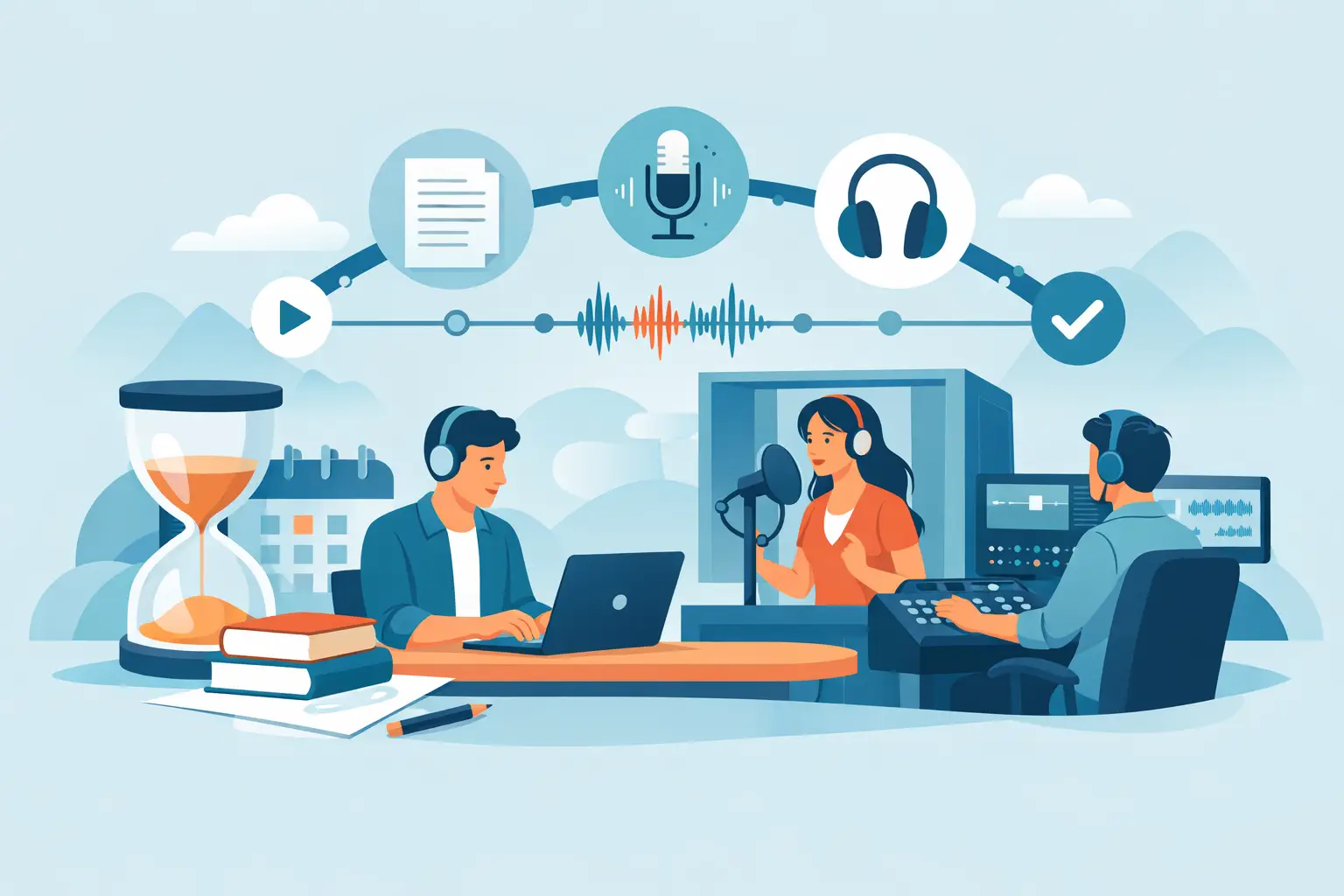
A finished manuscript is not yet an audiobook-ready manuscript. For authors, an audiobook production timeline begins when the text is stable enough to perform, not merely ready enough to upload. A late chapter rewrite, an unresolved pronunciation, or a vague character brief can force work backward through casting, recording, editing, and mastering. The fastest path to a polished release is a controlled sequence of decisions.
For a typical finished book, allow six to ten weeks from final manuscript lock to retailer-packaged audio. A shorter nonfiction project with one narrator and minimal sound can move faster. A long novel, a full-cast production, or a title with purposeful ambience and complex character work may need twelve weeks or more. Length matters, but the bigger variable is how decisively the author and production team handle approvals.
Start the Audiobook Production Timeline With a Locked Manuscript
Audiobook production should start after developmental edits, copy edits, and proofreading are complete. That does not mean every future edition of the book is frozen forever. It means the version sent to audio has an approved text, stable chapter order, confirmed front and back matter, and no pending scene-level revisions.
This distinction protects the production schedule. In print and ebook workflows, changing a paragraph may be a straightforward correction. In audio, that paragraph may affect a narrator's performance, an edited chapter file, timing between scenes, a sound cue, and a completed master. A correction is still possible, but its cost rises as the project advances.
Before script preparation, authors should also make practical decisions that are easy to overlook: whether the audiobook will include an introduction, acknowledgments, epigraphs, endnotes, bonus chapters, or a sample from the next book. Decide how URLs, tables, citations, emails, and visual references will be handled for listeners. Nonfiction authors should identify every specialized term, name, acronym, location, and brand that requires a pronunciation decision.
This manuscript-lock stage commonly takes three days to two weeks, depending on whether the book is genuinely final. Rushing it to meet a launch date often creates a longer delay later.
Weeks 1-2: Build the Production Script and Casting Brief
A production script is not just a manuscript placed in a recording window. It is an editable working document that tells the production team what must be said, how it should be interpreted, and where the listening experience needs special attention.
During this stage, chapter headings are standardized, narration notes are added, and non-spoken material is marked for removal or adaptation. Dialogue-heavy fiction benefits from character notes that cover age range, vocal quality, accent requirements, emotional baseline, relationships, and change over the series. Memoir and business nonfiction need a different kind of direction: authorial pace, authority, warmth, technical vocabulary, and moments where a listener needs room to absorb an idea.
Casting should happen from a clear brief, not a generic request for a pleasant voice. The right narrator is determined by the book's demands. A first-person thriller may need intimacy and controlled tension. Epic fantasy may require distinct but sustainable character voices across many hours. A leadership book may need directness without sounding like a corporate presentation.
Give yourself time to review auditions, compare interpretations, and provide targeted feedback. For full-cast or multi-voice work, casting can add a week or two because voices must work together across scenes. The trade-off is straightforward: more voices can create a cinematic experience, but they introduce more scheduling, continuity, and mix decisions.
Platforms such as Orpheus are designed around this production reality, giving authors an editable script and a meaningful role in voice casting rather than reducing the book to an unreviewed text-to-speech export.
Weeks 2-5: Narration and Performance Review
Once casting is approved, narration begins. Recording time is not the same as finished-audio time. A narrator may produce several finished hours of performance per week, but that output still requires editing, review, pickup recording, and technical finishing.
A useful planning measure is finished runtime. Many books run roughly 9,000 to 9,500 words per finished hour, though dialogue density, pacing, poetry, technical material, and dramatic pauses can change that number. An 80,000-word novel may become eight to nine hours of audio. A 40,000-word nonfiction book may land near four to five hours.
Authors should review an early sample or first completed chapter before the entire book is performed. This is the right time to correct character interpretation, cadence, pronunciation, and treatment of headings or quoted material. Feedback should be specific. “The voice feels off” is hard to act on. “Slow the pace slightly in the case-study sections and make the narrator's tone less sarcastic in dialogue” gives the team a usable direction.
After that approval, avoid rewriting performance choices chapter by chapter unless there is a genuine continuity issue. Consistency is a core quality standard in audiobook production. A listener should not hear a protagonist's voice, a technical term, or the narrator's pacing shift without a story-driven reason.
For a single-narrator title, narration and first-pass review often take two to four weeks. Full-cast work, long books, or productions with multiple approval rounds can extend this stage. Build in time for pickups: short re-recorded lines used to fix a pronunciation, missed word, noise issue, or approved text correction.
Weeks 4-7: Edit, Add Sound With Restraint, and Master
Editing turns raw performance into clean, continuous listening. It removes mistakes, unwanted breaths or mouth noise where appropriate, long pauses, duplicate takes, and recording artifacts. The goal is not sterile audio. Natural performance still needs breath, rhythm, and emotional space.
Sound design and ambience belong here, but only when they serve the book. A restrained room tone, environmental texture, transition, or scene-opening cue can deepen immersion. Constant music, aggressive effects, or ambience under every sentence can compete with the narration and fatigue the listener. The best choice depends on genre, narration style, and audience expectation.
Mastering then brings the project to a consistent technical standard. Levels, loudness, equalization, noise floor, spacing, and chapter boundaries are checked so the book plays reliably from beginning to end. This is also where a production team confirms that credits, opening language, closing language, and chapter files match the approved script.
Editing and mastering may overlap with late narration on longer projects, but final mastering cannot be rushed before all pickups are complete. Plan one to two weeks for this stage on a standard book, with more time for extensive sound work or a large number of chapters.
Weeks 7-9: Quality Control and Retailer Packaging
Quality control is the last creative and technical gate before distribution. A serious QC pass checks more than obvious errors. The reviewer listens for missing or repeated words, inconsistent character voices, incorrect pronunciation, abrupt edits, incorrect chapter names, uneven levels, unintended silences, and sound effects that arrive too early or linger too long.
Authors should receive a clear review window and concentrate their notes. Flag real issues with chapter and timestamp references whenever possible. This prevents vague back-and-forth and makes corrections faster. It also helps distinguish a production defect from a subjective preference that was already approved during the sample stage.
Once corrections are complete, audio files are rendered and packaged to retailer requirements. That includes correctly organized chapter files, metadata alignment, opening and closing credits where needed, and technical files ready for platform ingestion. Retailer review and publication timing sit outside the core production schedule, so authors with a fixed launch date should leave a buffer after final delivery.
Plan Backward From the Release Date
If your ebook and print edition are launching on a specific day, do not set the audiobook deadline for that same day. Set the audio production deadline earlier, then work backward through retailer processing, QC, mastering, recording, casting, and manuscript lock. For a coordinated release, starting eight to twelve weeks ahead is sensible for most independently published titles.
Series authors can gain time by maintaining a pronunciation guide, character bible, approved voice references, and consistent front and back matter across books. Those production assets reduce repeated decisions without removing creative control. Each new title can still earn its own casting and performance choices.
The best audiobook schedule does not treat audio as the final box to check after print and ebook files are done. Treat it as its own production track, with its own script, approvals, technical standards, and listener experience. That approach gives your book the time to sound intentional when it reaches someone through headphones, in a car, or at the end of a long day.
Last updated August 27, 2026
← All posts