Narration Workflow Tools for Better Audiobooks
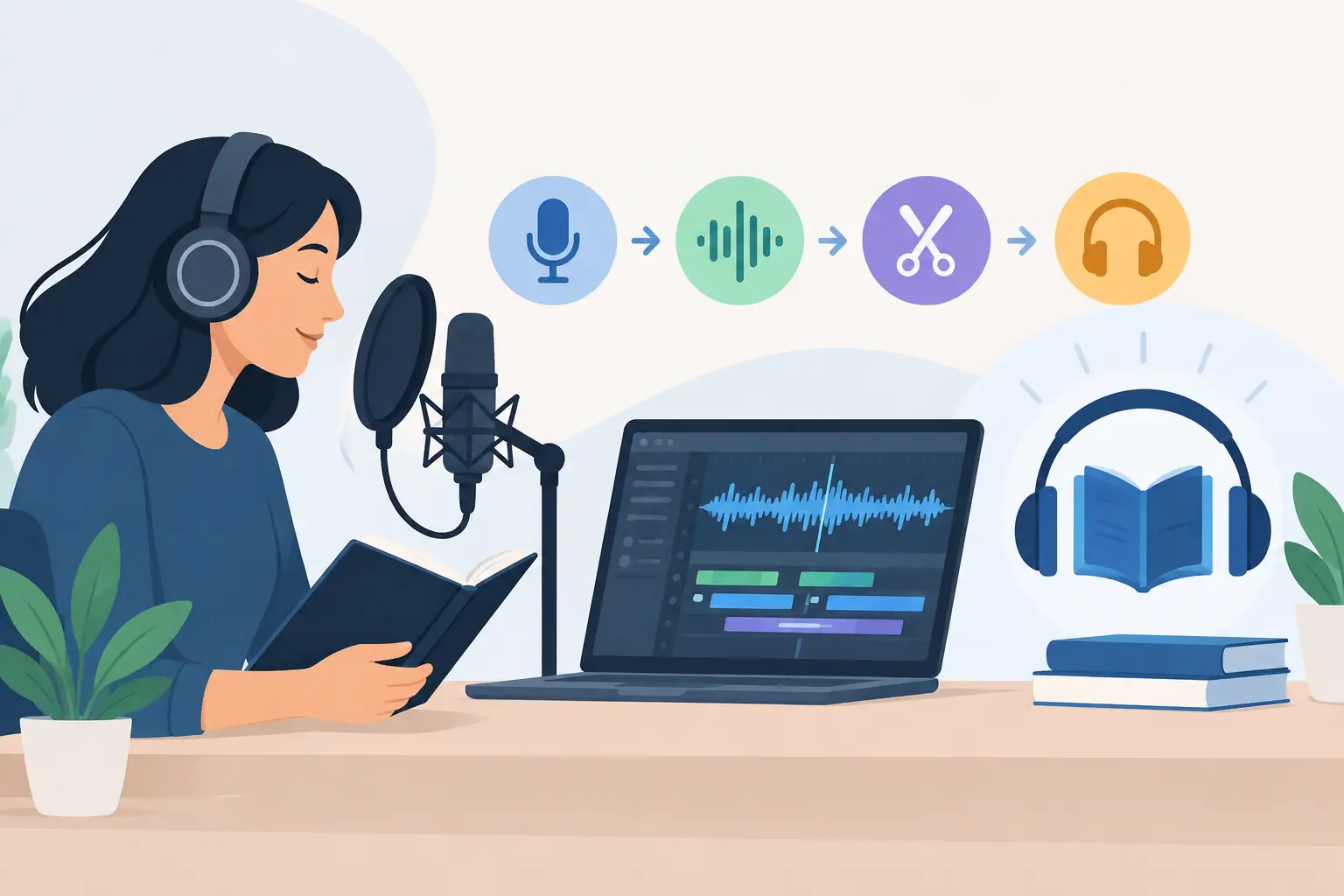
A completed manuscript is not an audiobook waiting to happen. It is source material for a separate production process with its own editorial decisions, casting requirements, audio standards, and delivery rules. The right narration workflow tools give authors a way to manage that process without reducing the listening experience to a generic text-to-speech export.
For independent authors and lean publishing teams, the question is not simply which tool can generate the fastest audio. The better question is whether the system preserves control at every decision that affects the book: what the narrator says, how characters sound, where a pause belongs, whether a scene needs atmosphere, and what files reach retailers.
Why Audiobook Production Needs a Workflow
Audiobook production has dependencies. A script cannot be finalized until the manuscript is stable. Casting is difficult when character notes are scattered across a draft. Recording or voice generation cannot move confidently forward if pronunciation choices and chapter breaks are unresolved. Mastering is not the stage for discovering that a line was omitted three chapters earlier.
When those dependencies live in email threads, marked-up PDFs, spreadsheets, and folders with unclear file names, the production team spends time coordinating instead of producing. That may be manageable for one short title. It becomes expensive and error-prone for a series, a growing backlist, or a small press releasing multiple books each season.
Purpose-built narration workflow tools organize the handoffs between stages. They turn a manuscript into an editable production script, connect casting to actual character and chapter context, and keep approved creative choices attached to the audio being produced. The result is not less author involvement. It is more useful involvement, focused on decisions only the author or publisher should make.
Start With the Production Script, Not the Audio
The first job is to create a production script that is distinct from the print manuscript. Print pages contain visual conventions that do not always translate to listening. Chapter ornaments, scene-break symbols, epigraph formatting, footnotes, text messages, tables, and citations all need deliberate treatment.
A good script workflow lets the author review how these elements will be spoken, adapted, or omitted. In nonfiction, this might mean deciding whether a source URL should be read aloud, shortened, or referenced in accompanying material. In fiction, it may mean clarifying whether a line is internal thought, dialogue, or narration. Memoir often demands extra care around names, locations, dates, and emotionally significant pacing.
This is also the best moment to establish pronunciation guidance. Do not treat pronunciation as a minor cleanup task. Place names, invented terms, brand names, historical references, and multilingual dialogue can change the credibility of the entire production. A centralized script should hold those decisions where narrators and producers can apply them consistently.
The trade-off is time upfront. Script preparation can feel slower than sending a manuscript directly to a voice engine. But a rushed script usually moves uncertainty downstream, where corrections affect recorded chapters, mixes, approvals, and release dates.
Protect the Manuscript Version
Only begin final audio production from a locked manuscript version. Small late edits are normal, but they should be tracked as controlled changes, not silently inserted into an active production file.
For series authors, version discipline matters even more. Character names, recurring terminology, and prior pronunciation choices should be available when the next installment enters production. Consistency is part of what makes a series feel professionally produced.
Casting Is a Creative Decision, Not a Checkbox
A voice is part of the book's identity. The right narrator or cast supports genre expectations, point of view, character distinctions, pacing, and emotional range. A thriller may need restraint and momentum. A romance may require intimacy without melodrama. Business nonfiction needs clarity and authority, while a personal memoir may call for a closer, more conversational performance.
Narration workflow tools should make casting reviewable rather than opaque. Authors need a practical way to assess sample reads, compare candidate voices, assign voices to specific roles when appropriate, and document why a choice was made. That record is valuable when revisions arise or when a sequel needs continuity.
Multiple voices are not automatically better. Full-cast production can add energy to dialogue-heavy fiction, but it introduces scheduling, continuity, and mixing complexity. A skilled single narrator may produce a more cohesive experience for many novels and nonfiction books. The right approach depends on the manuscript, budget, audience expectations, and release plan.
What matters is that the author can make the choice intentionally. A production platform should not force a book into one generic voice because that is the easiest output to generate.
Evaluate Narration Workflow Tools by the Handoffs
Many tools can create audio. Fewer support the work surrounding audio creation. When evaluating a workflow, look at what happens between the major stages.
First, consider manuscript intake and script editing. Can the team prepare an audio-specific script without losing the connection to the original text? Can edits be reviewed and approved in context? If a paragraph changes, is it clear what audio needs to be revised?
Next, examine casting and direction. Does the workflow support character notes, voice assignments, pronunciation guidance, and performance direction? These controls matter whether the production uses professional talent, licensed synthetic voices, or a hybrid approach.
Then look closely at audio review. A useful system gives authors a way to listen by chapter, identify issues precisely, request changes, and confirm approvals. “Something sounds off around the middle” is not an efficient note. “Chapter 8, paragraph 3: pronunciation of the town name differs from Chapter 2” is actionable.
Finally, assess mastering and delivery. Retail-ready audio requires more than acceptable voice output. Files need consistent levels, clean edits, appropriate chapter separation, correct metadata, and packaging that meets the requirements of the intended distribution channels. If retailer packaging is left to a separate manual process, the supposed efficiency of the workflow can disappear at the finish line.
Use Sound Design With Restraint
Selective sound design can strengthen an audiobook when it serves the text. A subtle room tone, a transition cue, or controlled ambience can help establish place and movement. Used heavily, effects can compete with narration, date the production, or distract listeners who want the story and nothing else.
The useful question is not whether a book can have sound design. It is whether a specific sonic choice improves comprehension, mood, or pacing. Fiction with cinematic scope may benefit from a carefully designed atmosphere. A leadership book may need only a clean, confident narration. Every effect should have a production reason.
This is another area where author control matters. Sound is interpretive. A rain effect, a music bed, or a dramatic transition can alter how a scene lands. Review and approval should be built into the workflow before the final mix, not handled as an afterthought.
Build a Repeatable Approval Path
A clear approval path protects both quality and schedule. The author should know when they are reviewing script changes, casting choices, sample audio, completed chapters, and the final master. Production teams should know which feedback is a required correction, which is a preference, and which stage has been approved.
Avoid reopening every creative decision at every stage. Once casting is approved, feedback should focus on performance consistency and script accuracy, not restart the entire casting process unless there is a genuine problem. Once the script is locked, new manuscript edits should be weighed against their production impact.
This is not bureaucracy. It is how a team finishes a polished audiobook without exhausting the people making it.
A platform such as Orpheus is designed around this production reality: an editable script, casting control, selective sound design, reviewable production decisions, mastering, and retailer-packaged audio are connected as one system rather than treated as unrelated tasks.
Choose Control Over Convenience Theater
The fastest route to audio is not always the fastest route to a release you are proud to attach to your name. One-click generation can be useful for internal review, accessibility drafts, or early experimentation. It is rarely enough for authors who view audio as a commercial edition of their work.
Choose narration workflow tools that make the production visible. You should be able to see the script, hear the creative choices, approve the changes, and receive files prepared for distribution. When the workflow is built around those moments, the audiobook remains yours from first page to final listen.
Last updated October 21, 2026
← All posts