AI Audiobook Quality: What Authors Should Control
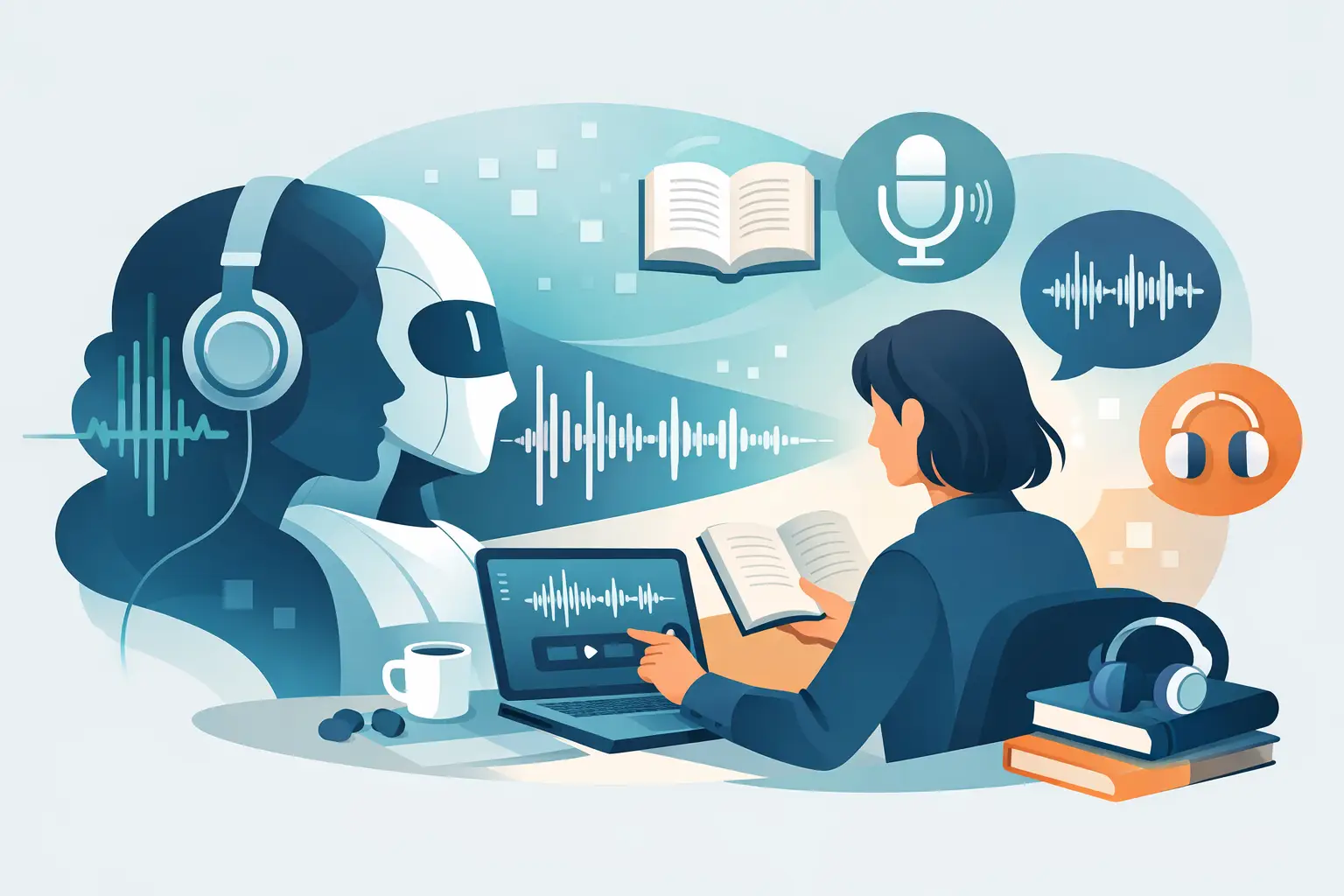
A listener can forgive a pause. They rarely forgive a voice that changes personality halfway through a chapter, dialogue that lands with the wrong emotional weight, or audio that feels unfinished in their headphones. AI audiobook quality is not determined by whether a synthetic voice sounds human in a short demo. It is determined by whether the complete book holds together as a deliberate listening experience.
For independent authors, that distinction matters. Audiobooks sit beside professionally narrated releases in retailer catalogs, and listeners judge them against that standard. A completed manuscript is the starting material, not the finished audio product. The quality gap appears in the work between those two points: script preparation, casting, performance direction, sound decisions, mastering, and delivery.
AI Audiobook Quality Is a Production Standard
Basic text-to-speech treats the manuscript as a block of text and returns a recording. That approach can be useful for personal listening, accessibility, rough proofing, or temporary internal reference. It is not automatically a commercial audiobook workflow.
A retail-ready audiobook has to make consistent choices over many hours. The narrator needs to understand which lines are narration, which are dialogue, where a character enters, how a name is pronounced, and when a pause carries meaning. A nonfiction book needs an equally intentional approach to headings, quotations, citations, exercises, sidebars, and transitions. If those decisions are left to an unedited source file, even a capable voice model will expose the manuscript's hidden production problems.
The question is not whether AI can generate audio. It clearly can. The better question is whether the author can control the decisions that make generated audio credible, coherent, and appropriate for the book.
A natural voice is only one layer
Voice realism gets most of the attention because it is easy to hear in a 30-second sample. But a full-length audiobook tests much more than tone. Listeners notice inconsistent pronunciation, rushed phrasing, misplaced emphasis, identical character voices, abrupt pacing changes, and chapter files with uneven loudness. They also notice when the performance does not match the genre.
A close first-person thriller may need intimate narration with controlled tension. A romantic comedy may need sharp timing and clear character contrast. A business book needs authority without sounding mechanical or overperformed. Memoir often depends on restraint, vulnerability, and the careful handling of names, places, and personal history. There is no single "best" AI voice for every one of these jobs.
That is why casting should be a creative decision, not a default setting. The right voice is the one that serves the manuscript, audience expectations, and author intent across the entire runtime.
Start With an Editable Production Script
The most effective quality control begins before narration. A manuscript designed for print or ebook reading may contain elements that need different treatment in audio: scene breaks, epigraphs, image descriptions, URLs, tables, footnotes, citations, and stylized typography. Without a production script, these elements can become awkward, confusing, or accidentally omitted.
An editable script gives the author and production team a place to make audio-specific choices without damaging the source manuscript. It can clarify character assignments, pronunciation guidance, pauses, emphasis, chapter titles, and sections that should be adapted for the ear. For nonfiction, it can identify material better summarized than read verbatim. For fiction, it can mark scene transitions and dialogue attribution that may need added clarity in audio.
This is also where authors should catch last-minute text changes. Recording from an outdated manuscript creates expensive confusion in any production model. With AI narration, it can also create subtle continuity problems if a revision changes a name, a line of dialogue, or an established pronunciation late in the process.
A controlled workflow treats the script as the production source of truth. That makes revisions traceable and keeps narration, sound, and final files aligned with the book readers will buy.
Casting and Character Direction Need Human Judgment
Multi-character work is where generic AI narration often loses credibility fastest. Assigning a different voice to each character is not enough. Voices must be distinct without becoming distracting, plausible for the setting, consistent from chapter to chapter, and understandable when dialogue moves quickly.
Authors do not need to direct every sentence at the level of a studio performance. They do need authority over the creative framework. That means approving the primary narrator, selecting character voices where the story requires them, establishing pronunciation rules, and listening to representative scenes before committing to the full book.
Test the most demanding material, not just the opening page. Choose a scene with overlapping dialogue, emotional movement, proper nouns, internal monologue, and a shift in pacing. For nonfiction, test a section with terminology, quoted material, numbers, and a dense explanation. A voice that performs well in a simple sample may not carry the book's difficult passages.
Consistency matters more than novelty. A restrained cast that remains stable for ten hours is better than a collection of flashy voices that pull the listener out of the story.
Sound Design Should Support the Page, Not Compete With It
Cinematic audio does not require constant music or effects. In fact, excessive sound design can make an audiobook feel dated, cluttered, or exhausting. Sound earns its place when it supports orientation, atmosphere, or emotional transition without obscuring the narration.
A brief ambience change may help establish a new location. A subtle cue can separate a memory, document, or dream sequence from the main timeline. An opening or closing treatment can create a polished frame for the release. But an effect placed under every conversation usually asks the listener to notice production rather than story.
The right amount depends on genre and author intent. A fantasy serial may benefit from a stronger sonic identity than a practical leadership book. A literary novel may call for almost none. The quality standard is not how many layers the mix contains. It is whether every layer has a reason to be there.
Mastering Is Where Good Work Can Still Fail
Strong narration and careful casting can be undermined by poor final audio. Mastering brings the project into a consistent technical state: stable loudness, controlled peaks, clean transitions, appropriate spacing, and a balanced listening level across chapters. It is the stage that prevents one chapter from sounding noticeably louder, thinner, or more compressed than the next.
Retailer packaging matters too. Audiobook platforms expect organized chapter files, accurate metadata, and audio that meets their delivery requirements. A book may sound acceptable on a desktop speaker and still fail technical review or create a poor experience on earbuds, in a car, or at low volume late at night.
Authors should treat mastering and retailer packaging as production deliverables, not administrative cleanup. They are part of the listener's experience and part of the book's commercial readiness.
A Practical Review Pass Before Release
Before approving final files, listen strategically rather than trying to inspect every minute in one sitting. Review the opening and closing of every chapter, then sample dialogue-heavy and emotionally important scenes. Listen on the devices your audience actually uses, especially headphones and a car system if possible.
Check four areas: pronunciation and continuity, character differentiation, pacing and emotional fit, and audio consistency between files. Keep a single revision log tied to the production script. Vague feedback such as "make it better" slows decisions; a clear note such as "Chapter 8, 04:12, the surname is pronounced differently from Chapter 2" can be fixed precisely.
A platform built for this work should preserve that control. Tunmire's Orpheus is designed around an editable script, narration and character voice casting, selective sound design, mixing, mastering, and retailer-packaged delivery because those stages are where a manuscript becomes a finished audio release.
The best use of AI in audiobook production is not replacing authorship with a button. It is giving authors a faster path to professional execution while keeping the decisions that define the book in their hands. If a listener finishes your audiobook thinking about the story, argument, or experience instead of the technology behind it, the production has done its job.
Last updated September 2, 2026
← All posts