AI Narration Versus Voice Actors for Authors
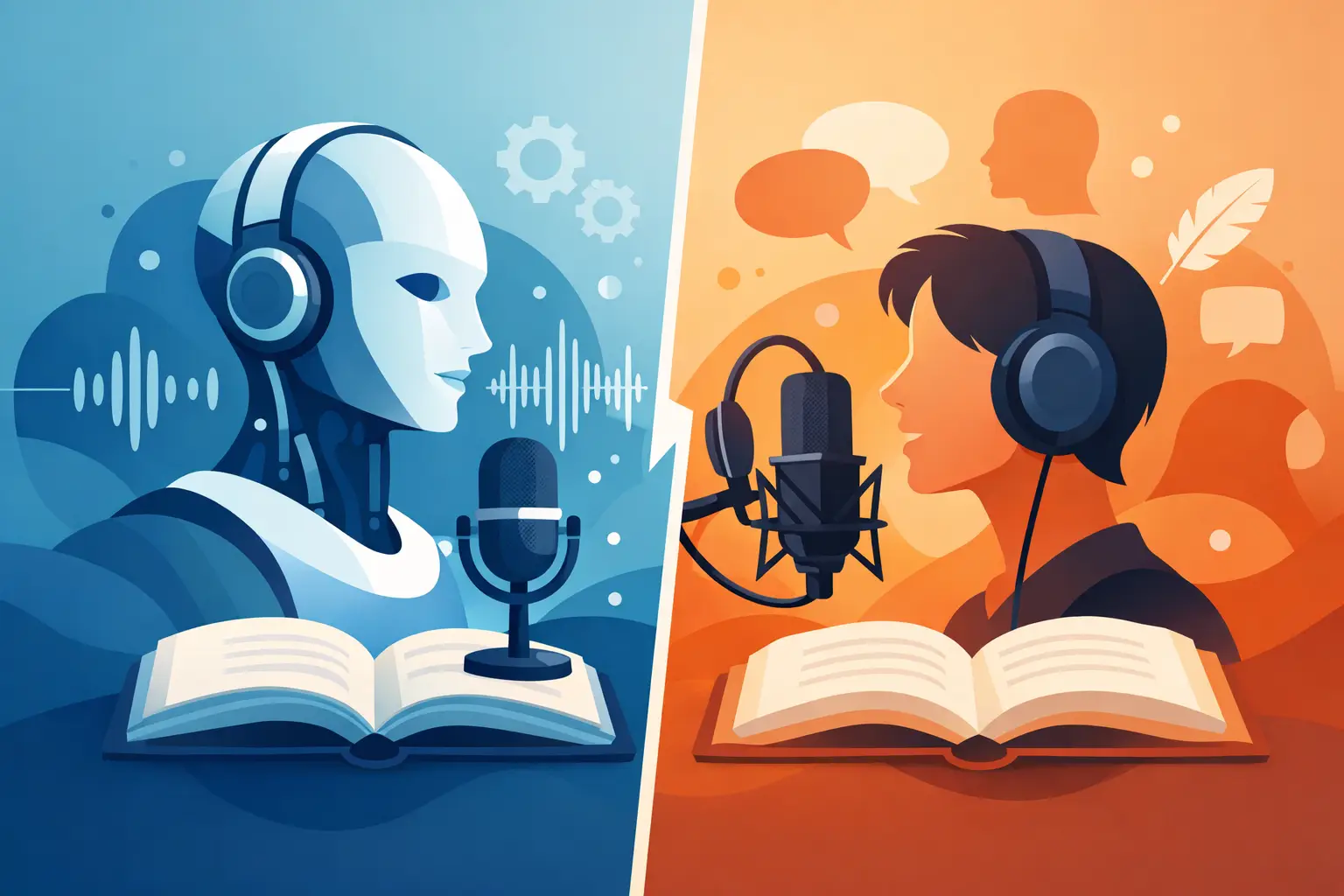
A completed manuscript can become a strong paperback, a validated EPUB, and a weak audiobook if the audio is treated as an afterthought. The AI narration versus voice actors decision is not simply a question of budget or speed. It determines how readers encounter your characters, absorb your expertise, and judge the production standards of your publishing business.
For independent authors, the useful question is not, "Is AI better than a human?" It is: what kind of listening experience does this book require, and how much creative control must remain in your hands from script through retailer packaging?
AI Narration Versus Voice Actors: The Real Difference
Basic text-to-speech turns written words into sound. Audiobook production turns a manuscript into a performance. Those are different jobs.
A voice actor brings interpretation. They decide where a line needs restraint, when a character is masking fear, how quickly a scene should move, and whether a pause carries more force than another emphasized word. For literary fiction, character-driven romance, memoir, and narrative nonfiction, that interpretive work can be central to the book's value.
AI narration works from a different strength: controlled repeatability. A well-directed synthetic voice can maintain consistent pronunciation, pacing, and vocal identity across a long manuscript or a multi-book series. It can also make audio viable for projects that would otherwise remain print and ebook only.
Neither approach removes the need for production judgment. A human performance still needs a clean script, retake direction, editing, proofing, mastering, and delivery files prepared to retailer specifications. AI narration still needs casting, pronunciation review, pacing decisions, chapter-level quality control, and an editor who can catch a line that sounds technically correct but emotionally wrong.
The gap is not between automated and professional. The gap is between an unmanaged export and a deliberate production workflow.
Start With the Book, Not the Narration Method
Genre, narrative distance, and audience expectations should lead the decision. A thriller with a large cast, shifting points of view, and rapid dialogue places heavy demands on any narrator. A single voice that handles every character poorly can break immersion, whether that voice is human or synthetic.
A practical nonfiction title may have different priorities. If the book is instructional, concise, and frequently updated, speed and revision flexibility may matter more than a highly interpretive delivery. AI can be a strong option when the author needs to update figures, add a new chapter, or keep a growing backlist available in audio without restarting an entire recording schedule.
Memoir requires particular care. Readers often expect intimacy and credibility. Sometimes the author is the only voice that can carry the material. Sometimes a skilled actor provides the distance and polish the author cannot achieve alone. A synthetic voice may suit a straightforward business memoir, but it is less likely to satisfy a work built on vulnerability, grief, humor, or a distinctive lived voice.
Series authors should also think beyond one release. Consistency becomes an asset over five, ten, or twenty books. A human narrator may become part of the series brand, but availability, rates, and recording schedules can change. AI voices can offer continuity, provided the author can preserve the approved voice, character choices, and pronunciation standards across every installment.
Where Voice Actors Earn Their Cost
A professional narrator is not paid only for time at a microphone. You are paying for performance skill, preparation, vocal stamina, character differentiation, and the ability to make difficult prose sound natural. The right actor can reveal strengths in a manuscript that the silent page only suggests.
Voice actors are usually the better choice when the performance itself is a selling point. This includes novels with emotionally complex dialogue, fiction with a devoted audio audience, memoirs where personal presence matters, and books intended to compete at the highest commercial level in a crowded category.
The trade-off is coordination. Authors and small presses must align schedules, approve auditions, establish pronunciation preferences, manage pickups, and budget for editing and mastering. A narrator can be excellent and still be the wrong casting choice. That is why a short sample from the actual manuscript is more informative than a polished general demo.
Human narration can also introduce continuity risk. If a series begins with one narrator and later books require a replacement, readers notice. If the narrator's interpretation drifts from the author's intent, changes may be expensive to correct after recording. Creative authority needs to be defined before the first chapter is produced.
Where AI Narration Can Be the Smarter Production Choice
AI is most useful when it expands a publishing operation without lowering its standards. It can shorten the path from finished manuscript to audiobook, support rapid releases, and make more backlist titles economically viable. For independent teams managing multiple formats, that capacity matters.
It is especially practical for nonfiction with clear, direct prose; reference-driven titles that may need updates; shorter works; and catalog projects where a polished audio edition is valuable but a full studio production is not commercially justified. It can also help authors test audio demand before committing to a larger human-narrated edition.
But synthetic narration has limits that authors should assess honestly. Character dialogue can become flat. Comic timing may miss. Emotional turns may sound over-signaled or underplayed. Unusual names, invented terms, citations, tables, and foreign-language phrases all require review. A model may pronounce every word accurately while still delivering a sentence with the wrong meaning.
That is why one-click generation is a poor standard for a commercial audiobook. The author needs the ability to review an editable production script, select or cast voices intentionally, adjust problematic passages, and approve the final mix. AI can accelerate production, but it should not make the creative process invisible.
Build an Audiobook Workflow That Preserves Control
Whether you choose AI, voice actors, or a hybrid approach, begin with script preparation. The audiobook script is not merely the manuscript copied into another interface. It should identify chapter breaks, front and back matter, notes for pronunciation, character names, scene changes, and any content that needs adaptation for listening.
Next comes casting. With a human narrator, that means auditions that include your actual dialogue and difficult names. With AI, it means evaluating voices for more than pleasant tone. Listen for sustained pacing, consonant clarity, emotional range, and how the voice handles the specific cadence of your prose. A voice that sounds impressive in a thirty-second sample may become tiring over eight hours.
Then establish a review process before the whole book is produced. Approve a representative section containing narration, dialogue, technical terms, and a tonal shift. Keep a pronunciation guide and production notes. For series, maintain a voice bible that records character treatment, recurring terms, and approved choices. This protects consistency even when books are produced months apart.
The final stages are where many low-cost projects fail. Audio must be edited for errors and awkward pacing, mixed to support intelligibility, mastered to consistent standards, and packaged correctly for retailer delivery. Selective ambience or sound design can strengthen a scene, but only when it serves the narrative. Constant effects often date an audiobook quickly and distract from the performance.
Platforms such as Tunmire's Orpheus are built around this production reality: script preparation, voice casting, author review, controlled sound design, mastering, and retailer-packaged files. The goal is not to make every book sound the same. It is to give authors a repeatable system for making purposeful choices at each stage.
The Best Choice May Be a Hybrid
Some books do not need a single answer. An author might use a voice actor for a flagship novel and controlled AI narration for companion guides, novellas, or backlist nonfiction. A small press may reserve human talent for high-performing series while using AI to establish audio editions across its broader catalog.
Hybrid production can also be creative rather than merely financial. A human narrator may carry the main text while a distinct AI voice handles brief quoted documents, archival passages, or a recurring in-world device. That choice needs restraint and a clear artistic reason. If listeners cannot tell why the production changes voices, it will feel like a shortcut rather than a design decision.
Choose for the Listener You Want to Keep
The cheapest audiobook is expensive if it damages trust in your catalog. The most elaborate audiobook is also expensive if its production choices do not match the book or its market. Set the standard based on the listening experience your readers expect, then build a workflow that lets you approve the script, casting, performance, and final files with confidence.
Your manuscript already carries your voice. The production process should give that voice a form listeners will want to stay with, chapter after chapter.
Last updated September 9, 2026
← All posts